Supermog
Our software factory, now available to clients. Label a GitHub issue and a fleet of agents writes the code, reviews it with a second model, proves it works in a browser, on a phone, or in an emulator, and merges it.
- pull requests merged
- 644
- of pull requests opened, merged with no human edits
- 88.9%
- projects worked on
- 12
- model spend reported
- $10,477
August 19, 2026 to November 17, 2026, from the fleet's own records.
The fleet at work. The pixel mascot on each screen swings its hammer while that box has a job.
Overview
Supermog is the system we use to build our own products. It runs in our lab, on our hardware, against our repositories. Its one goal is to produce high-quality pull requests that are easy to verify.
We file an issue the way we would for a colleague. A while later there is a pull request with the code, a review, the replies to that review, and a recording of the change working. Most of the time nobody edits it before it merges. Much of Supermog was built this way, by Supermog.
We now offer Supermog to new clients under an Enterprise agreement: a software factory of your own, set up on your hardware and your repositories, with your team's review and merge rules. Contact us to see what it could do for your team.
How a Pull Request Gets Made
-
1. Start with an issue
Every pull request starts as a GitHub issue. Some come from a person testing an app and reporting a bug. Others come out of a design discussion with a coding assistant. If the work is worth delegating, we hand the issue to the fleet. Sometimes we build the feature ourselves alongside an assistant and use Supermog only for the review and verification steps.
-
2. Write the code
An agent reads the issue, works in a clean checkout, runs the project's tests and opens a pull request.
-
3. Review it with a different model
A second agent reviews the pull request. We get the best results when the reviewer is not the model that wrote the code: it does not share the author's blind spots. The author then answers every review thread and pushes fixes.
-
4. Verify it in the running app
A QA session starts the app from the pull request's code and uses it the way a person would, in a browser, on a phone, or in an emulator. Screenshots and a screen recording are posted on the pull request.
-
5. Merge it, or wait for a person
Each repository chooses. A verified pull request either merges itself or waits for a human to read it. When a merge leaves other open pull requests in conflict, the fleet rebases them and verifies them again.
The Models and Their Roles
- Claude (Sonnet and Opus) writes the code, addresses the review and resolves merge conflicts.
- Grok reviews the code and runs verification.
- Either role can be given to either model from a settings page.
Technology Stack
- Bun and TypeScript
- Cloudflare Workers and a Durable Object
- Docker on every agent box
- Playwright, adb, the Android emulator and the iOS simulator
- A GitHub App for all of its access
What Happened to Every Pull Request
Supermog records the fate of each pull request it opens. Of 665 so far:
Merged as written
591 · 88.9%
No person pushed a commit to the branch.
Merged after a human edit
52 · 7.8%
A person pushed at least one commit before merging.
Closed without merging
21 · 3.2%
The work was not wanted, or was redone another way.
Merged, then reverted
1 · 0.1%
A later commit undid the merge.
More Numbers
- runs
- 5,357
- Develop rounds, QA rounds and rebases, across 77 active days.
- spent developing
- 692 h
- Writing code, reviewing it, addressing the review and resolving conflicts.
- spent verifying
- 249 h
- 1,795 QA sessions in a browser, on a phone, or in an emulator.
- median time to merge
- 4.1 h
- From the pull request opening to its merge.
- lines added
- +284,770
- And 45,771 deleted, across 6,738 file changes in merged pull requests.
- longest verification
- 62 min
- The median session takes 5.8 minutes.
- longest coding step
- 90 min
- One uninterrupted run of the agent writing a pull request.
- median cost per merged pull request
- $6.95
- Every round on it added up: code, review, fixes and verification.
- runs on the busiest day
- 450
- September 5, 2026
The Largest Pull Request
"Move to Angular 22 and Ionic 9" for Olympia Fitness: 15,072 lines added and 20,555 deleted across 218 files, a framework migration delivered as one pull request.
What It Costs
The agents report what each step costs, and Supermog keeps the total: $10,477 across 2,903 runs. That log began partway through, so earlier runs are missing from it and the true figure is higher. The typical merged pull request cost $6.95, counting every round on it.
| Step | Spend | Share |
|---|---|---|
| Writing the code | $4,526 | 43% |
| Verifying | $2,090 | 20% |
| Addressing review | $1,889 | 18% |
| Learning from review | $729 | 7% |
| Reviewing | $696 | 7% |
| Resolving conflicts | $542 | 5% |
| Other steps | $5 | <1% |
Tokens behind that: 780 million in, 140 million out, and 24.1 billion read back from cache.
The Fleet
Supermog started on hardware we already had and grew as the queue did. Two Raspberry Pi 5s do most of the work. Two old Android phones, retired from daily use, are plugged into them over USB and serve as the test devices. An M6 MacBook Pro joins the fleet when a change needs an iOS simulator.
Some things a Raspberry Pi cannot do. Android's build tools and its emulator need an x86-64 machine, so we bought a Minisforum MS-A2 mini PC for that work and for running CI. Each box reports what it is able to do, and the queue gives every job to a box that can do it.
| Box | Hardware | Runs |
|---|---|---|
| pi-1 | Raspberry Pi 5, 8 GB | 2,543 |
| pi-2 | Raspberry Pi 5, 8 GB | 2,352 |
| mac | M6 MacBook Pro | 327 |
| sidekick | Minisforum MS-A2 | 135 |
Building the Pi Towers
Ninety minutes of assembly in sixty seconds. The Pis moved into Pironman 5 cases for NVMe storage and cooling. How the timelapse was made.
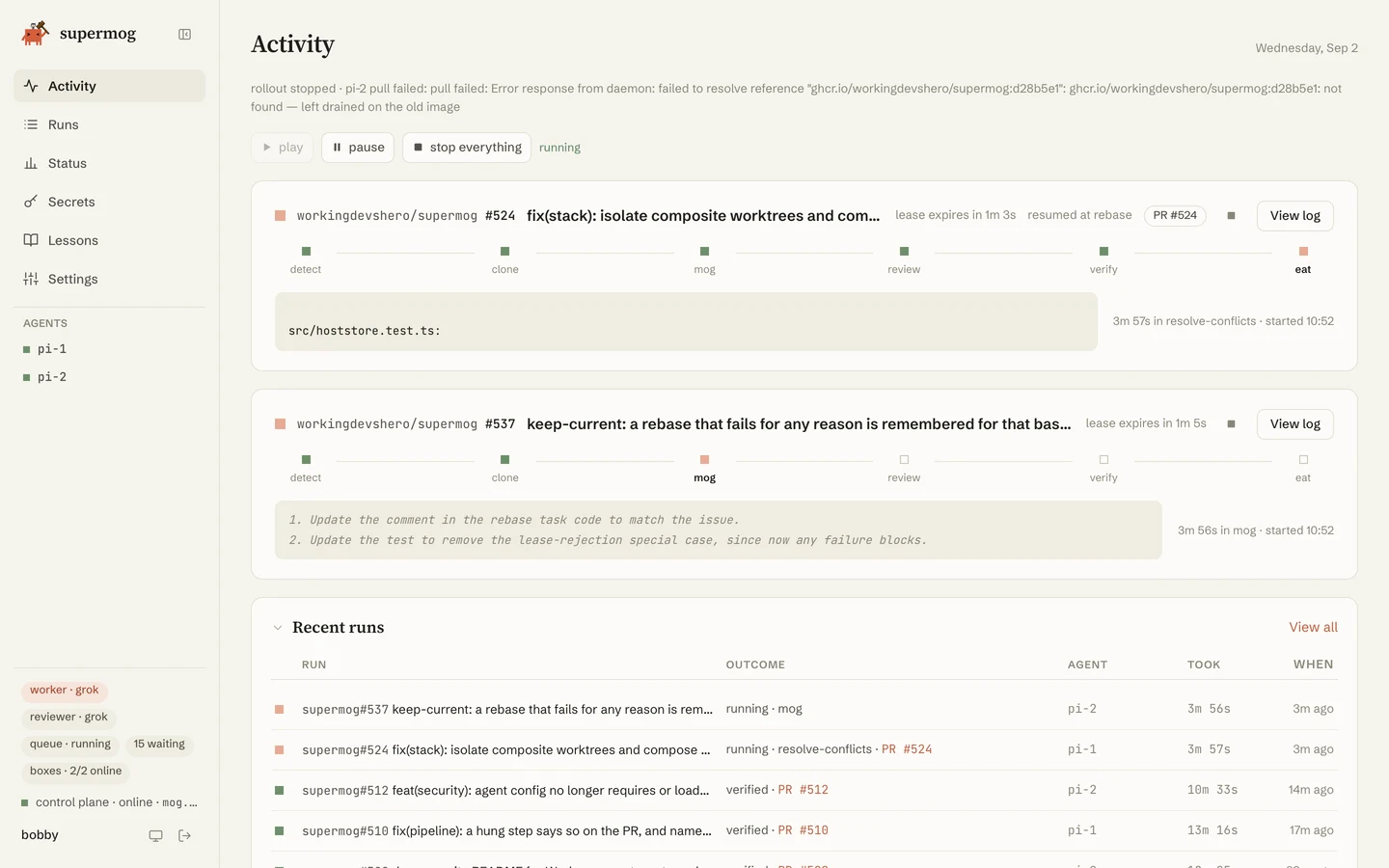
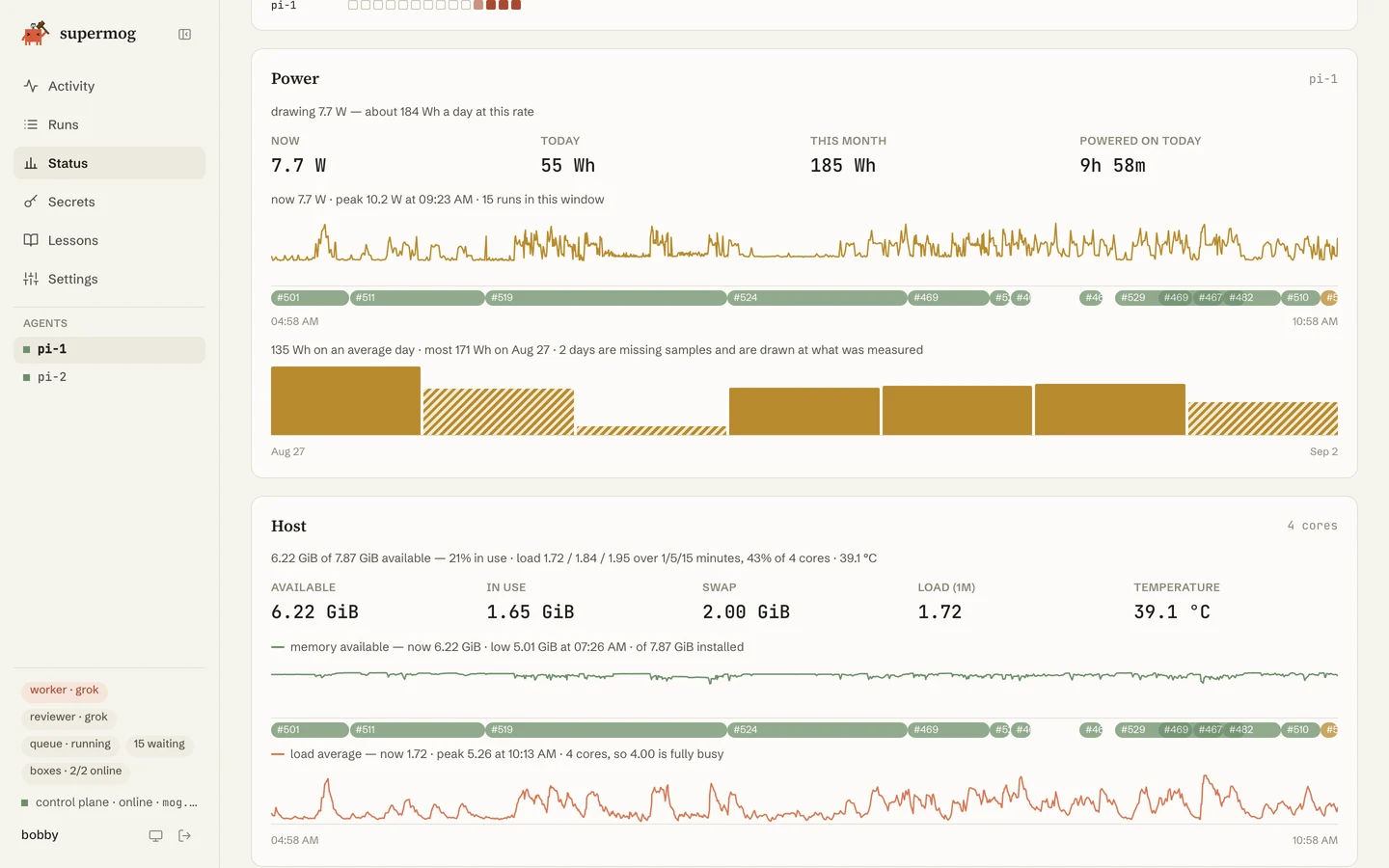
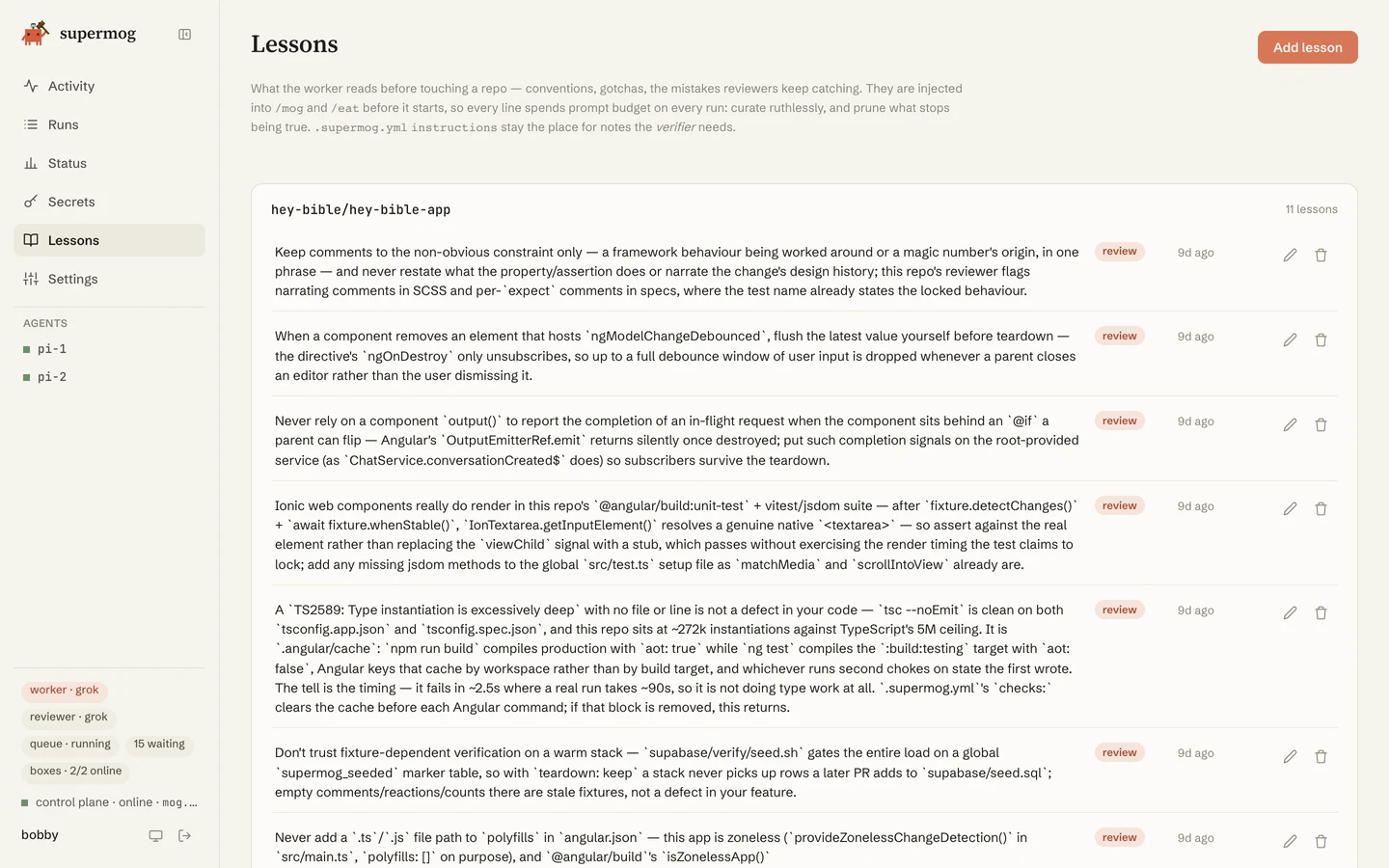
The Dashboard
Want a Software Factory of Your Own?
The products in our portfolio are built and verified by this fleet. We can build software for you with it, or set up a factory of your own under an Enterprise agreement, on your hardware and your repositories.